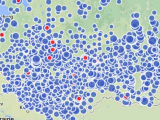
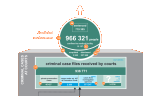
This memo suggestes summary of the study which examines the previously unexplored form of social support that inmates enjoy: money transfers. We study the distance decay of financial support of prisoners. Drawing on proprietary data from a Russian prison tech company, we explore the universe of money transfers to any penal facility in Russia in 2017–19. To estimate the distance effect we build a gravity model of remittance flows from 1,117 cities to 931 penal facilities. The features of Russian penal geography reflect on the volume, frequency, and direction of transfers received by inmates. The gravity model of remittances suggests a pronounced distance decay. Correctional facilities closest to the sender city (0...144 km away, 1st percentile of pairwise distance) receive almost 10 times more funds than the facilities located 9,789...13,625 km away from the senders (the 99th percentile).
Read more in the article preprint «Prisoner social ties, money transfers, and sender-recipient distance: Evidence from Russia (in English)
Text is availiable by the link (in Russian).
 We present a policy memo “Same Point of Law”: Citations of [Precedent] Cases in Commercial Courts". We examined 6.9 million texts of rulings of state commercial (“arbitrazh”) courts to identify references to judicial law-making: legal positions set forth by courts in similar cases. Some findings from this study:
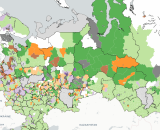
We also present the Precedent Atlas — an interactive map of cases, available at http://precedent.enforce.spb.ru. Read the full text (in Russian): full text.
The article ‘Is There a “Compensation Culture” in Contemporary Russia? The Role of Liability Insurance, Non-Pecuniary Damages, and Legal Profession in Personal Injury Litigation’ by Timur Bocharov has been published in the journal Oñati Socio-Legal Series. The article explores current trends in personal injury litigation in Russia compared with the common law countries (the UK and US). The specificity of the Russian situation is explained by the influence of the Soviet culture of tort law. The most visible areas of the Soviet impact addressed in the article are liability insurance, non-pecuniary damages, and the legal profession.The research is based on the analysis of judicial decisions on personal injury cases, court statistics, and expert interviews with personal injury lawyers.
Ekaterina Khodzhaeva has prepared an overview of the official statistics on jury trials held in regional and district courts. The main trends in 2018-2020 are:
- jurors acquit almost one third of defendants in district courts;
- but regional courts reverse three among five acquttals granted by juries.
More details are publlished here in Russian.
This paper examines the previously unexplored form of social support that inmates enjoy: money transfers. We study the distance decay of financial support of prisoners. Drawing on proprietary data from a Russian prison tech company, we explore the universe of money transfers to any penal facility in Russia in 2017–19. To estimate the distance effect we build a gravity model of remittance flows from 1,117 cities to 931 penal facilities. The features of Russian penal geography reflect on the volume, frequency, and direction of transfers received by inmates. The gravity model of remittances suggests a pronounced distance decay. Correctional facilities closest to the sender city (0...144 km away, 1st percentile of pairwise distance) receive almost 10 times more funds than the facilities located 9,789...13,625 km away from the senders (the 99th percentile). The distance decay is mitigated in cities where people are more exposed to the penal system. Uncovered distance decay of financial support is associated with stigmatization of prisoners’ families.
The preprint is avaliable by the link.
The journal Europe-Asia Studies published an article by Aryna Dzmitryieva, which examines the selection process for judges in the Russian Federation. Based on an analysis of the decisions of the qualification boards of judges, the article shows that, all other things being equal (level of education, demographic characteristics), unconditional priority in the selection is given to candidates with experience in the public sector. It also shows that the influence of court presidents on the JQBs’ decision-making in the selection process undermines judicial independence and accountability. Full text
In 2020, the Journal of Drug Issues has published the paper by Alex Knorre about discontinuities in heroin seized by Russian police. The paper is titled "Do Russian Police Fabricate Drug Offenses? Evidence From Seized Heroin’s Weight Distribution".
The text discusses the basic principles of the organization of prison medicine in several countries: Russia, the USA, Scotland, the Netherlands, and France. In the United States, treatment for prisoners is partly provided by private medical organizations. Prisoners in Scotland and France receive medical care from civilian medical institutions. In the Netherlands and Russia, by contrast, prison medicine is subordinate to the penal systems. The review is intended for public administration specialists, researchers of prison systems, and human rights advocates.
"The Law: Journal of Higher School of Economics" published the article "A Study in Complexity of Sentences Constituting Russian Federation Legal Acts" by Denis Saveliev, the IRL researcher.
The IRL assessed several state relief program expansion scenarios during the Pandemic. We based our estimation on firm registration data, staff employment, and financials for 2018–2019. Full text (in Russian)